
Dogoteka
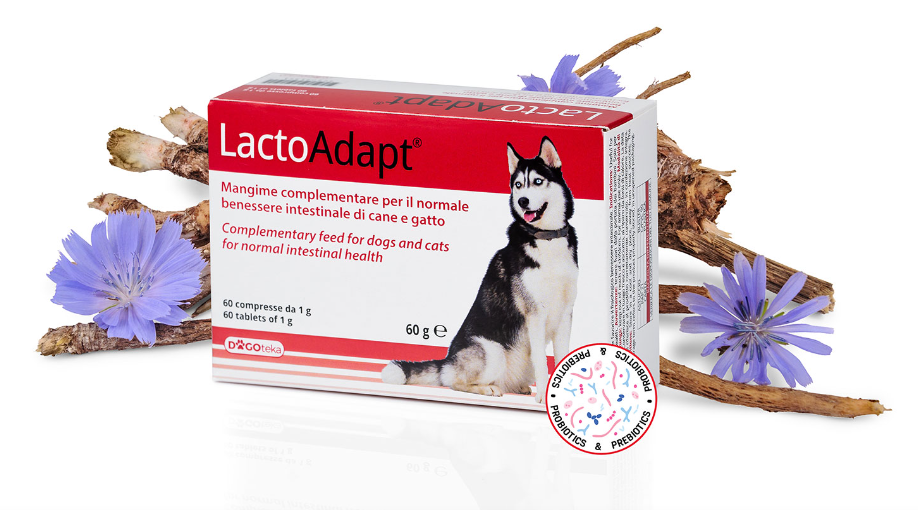
DOGOTEKA LactoAdapt 60 tablets.
DOGOTEKA LactoAdapt 60 tablets.
Couldn't load pickup availability
Description
Description
LactoAdapt
Complementary food for dogs and cats, designed to maintain a normal balance of intestinal flora, consisting of pre- and probiotics.
INDICATIONS :
LactoAdapt has a positive effect on the balance of intestinal flora, therefore it is useful in the following cases:
- using antibiotics
- changing diet
- eating disorders
- poisoning
- during periods of stress
- seasonal changes
PREBIOTICS
PREBIOTIC FIBER TRIO:
- FRUIT OLIGOSACCHARIDES (FOS)
- INULIN
- MANNAN OLIGOSACHARIDES (MOS) from brewer's yeast
FOS, MOS and INULIN are dietary fibers, i.e. indigestible carbohydrates, of unquestionable importance in both human and animal nutrition. Chemically, FOS and inulin are fructans (carbohydrates composed of repeating fructose units), with a short chain (FOS) and a slightly longer one (INULIN), and are particularly abundant in foods such as chicory and Jerusalem artichoke.
MOS is always a dietary fiber, but is composed of mannose repeats and is mainly derived from yeast cell walls.
All three substances act as prebiotics, that is, they can benefit health by regulating the intestinal microbiota, that is, the set of millions of microorganisms that are characteristic of the intestinal tract of various mammals. These microorganisms have a positive and vital effect on the health of the host. ((Suchodolski, 2011)). Indeed, there are several studies that consistently highlight the symbiosis between health maintenance and the balance of the intestinal microbiota.
How do prebiotic fibers positively affect the microbiota?
Humans and other mammals, including dogs and cats, do not have all the enzymes needed to break down plant fibers (e.g. fructooligosaccharides and inulin) in their intestines (Flint HJ, 2012), so these are not digested when they reach the small intestine, but are fermented by bacteria in the colonic microbiota, thereby positively affecting the abundance of certain beneficial bacterial groups (e.g. Lactobacillus and Bifidobacterium); this effect has a positive effect on a number of functions, such as intestinal motility, cellular integrity and microbial biochemical networks. (Scott KP, 2015).
Several studies have shown that integrating fructooligosaccharides into a dog's diet improves the absorption of various minerals and increases the number of Bifidobacteria, one of the beneficial microorganisms that actually live in the intestines of both humans and dogs and play an important role in the modulation of the immune system and digestive functions (Carlo Pinna1, 2018).
However, it seems that the mechanism of action of MOS prebiotics is different - various studies highlight their ability to selectively bind to receptors in the intestinal wall, making them inaccessible to pathogenic bacteria, which promotes the growth of good bacteria.
PROBIOTICS:
ENTEROCOCUS FAECIUM DSM 10663/NCIMB 10415 (35 X 10^9 CFU/g)
What are probiotics? In the feed sector, they are the so-called zootechnical additives that stabilize the intestinal flora, that is, microorganisms that, when given to animals, have a positive effect on their intestinal flora; (Europeo, 2003) they can actually colonize the intestines of the host animal, giving it a positive effect.
The attachment of a probiotic microorganism to the host intestinal mucosa is considered a crucial step for colonization and subsequent interaction with the host epithelium and its immune system. (Mohsen Hanifeh, 2021). Indeed, both pathogenic and commensal microorganisms (Commensals are microorganisms that live on any surface of the body or near the mucosa, without harming the health of humans/animals) secrete various adhesin molecules on their surface, allowing them to attach to various surfaces of the host. For this reason, when selecting strains of microorganisms with a probiotic effect, they must be characterized by a high ability to attach to the intestine.
Some studies have shown that this ability is related to host specificity; therefore, to be effective as a probiotic, the bacterial species should be of host intestinal origin, and Enterococcus faecium DSM 10663/NCIMB 10415 used in LactoAdapt exhibits this property.
Probiotics may improve mucosal health through several mechanisms, including the production of short-chain fatty acids (SCFA), antimicrobial agents, modulation of immune responses, competitive elimination of pathogenic bacteria by preventing their adhesion to the intestinal mucosa, and improvement of epithelial barrier functions.
INACTIVATED BACTERIA (LACTOBACILLUS HELVETICUS HA 122 (ex ACIDOPHILUS HA122), LACTOBACILLUS PARACASEI HA108, BIFIDOBACTERIUM BIFIDUM) : Inactivated microorganisms, also called tyndallized (Tyndallization is a sterilization method that destroys all phases of microbial development, including spores.), are treated with a certain thermal method that inactivates them, so they can no longer renew and multiply. Therefore, their activity is not related to the ability to create new offspring and thus colonize the intestine, but to the fact that they form a basis on which a suitable substrate is restored at the intestinal level for the colonization of symbiotic flora.
Sweet carob or sweet bean (Ceratonia siliqua L.) is an evergreen tree of the legume family, growing in arid and semi-arid regions of the Mediterranean basin. Despite their high sugar content, their pods are rich in insoluble fiber and trace elements, including phenolic compounds, inositols (mainly d-pinitol) and vitamins. (Aristea Gioxari 1, 2022)
YANG ®: This is a blend of inactivated yeasts, specifically Saccharomyces cerevisiae (commonly known as brewer's yeast) and Cyberlindnera jadinii.
Yeasts are unicellular eukaryotic organisms belonging to the kingdom of fungi.
Brewer's yeast (Saccharomyces cerevisiae) is particularly used in animal nutrition due to its nutritional value, as it is rich in valuable macronutrients such as protein, as well as micronutrients such as selenium and chromium, B vitamins and many other health-promoting substances.
This effect is primarily due to the abundance of nutrients.
Cyberlindnera jadinii is also a widely used yeast due to its nutritional value, as it is also rich in protein and vitamins.
PETMOD® NUCLEOTIDES FROM BREWERY'S YEAST Nucleotides are repeating units that make up nucleic acids (DNA and RNA). They consist of three components: a nitrogenous base (purine or pyrimidine), a 5-carbon sugar that, together with the nitrogenous base, forms a nucleoside, and one or more phosphate groups.
Some studies on fish have shown that dietary nucleotides have a beneficial effect on the intestine, promoting its growth and development. (Toshimasa Tsujinaka MD, 1999)
For this reason, there is a growing demand for the incorporation of nucleotides into pet food, with the ultimate goal of contributing to normal immune function and intestinal health in pets. (Natalia Russo1, Nucleotide inclusion in pet food: effect of heat treatment, 2019)
BANANA FLOUR Banana is a very popular fruit in the world market and is consumed as a staple food in many countries. It is consumed raw or processed, as well as as a functional ingredient in various food products. Bananas contain several bioactive compounds such as phenols, carotenoids, biogenic amines and phytosterols, which have many positive effects on health and well-being. Many of these compounds have antioxidant effects, protecting the body from oxidative stress. (Balwinder Singh a, 2015)
Some studies have shown that the polyphenolic component, specifically flavonoids, in addition to their antioxidant effects, also plays a positive role at the gastric level.
1 tablet contains :
Fructooligosaccharides FOS 50 mg
Inulin 50 mg
Mannanoligosaccharides MOS 75 mg
Sweet carob flour 25 mg
Yeast from inactivated Saccharomyces cerevisiae and Cyberlindnera jadinii 250 mg
Yeast products (Saccharomyces cerevisiae nucleotides) 5 mg
Banana flour 75 mg
Inactivated bacteria and their parts (Lactobacillus helveticus HA 122) 10 mg
Inactivated bacteria and their parts (Lactobacillus paracasei HA 108) 10 mg
Inactivated bacteria and their parts (Bifidobacterium bifidum SGB02) 2.5 mg
Enterococcus faecium DSM 10663/ NCIMB 10415 35 x 106 UFC
Dosage and method of use:
0-10 kg - 1 tablet
10-20 kg - 2 tablets
20-30 kg - 3 tablets
over 30 kg - 4 tablets
Give the tablets with the daily feed portion or directly into the animal's mouth. It is recommended to use the product without interruption.
Packaging :
LactoAdapt® Supplementary food for dogs and cats, useful for maintaining proper intestinal bacterial flora, 15 tablets of 1 g each.
LactoAdapt® Supplementary feed for dogs and cats, useful for maintaining regular intestinal bacterial flora, 60 tablets of 1 g.
Share
 Reksas AI
Reksas AI
