

Dogoteka
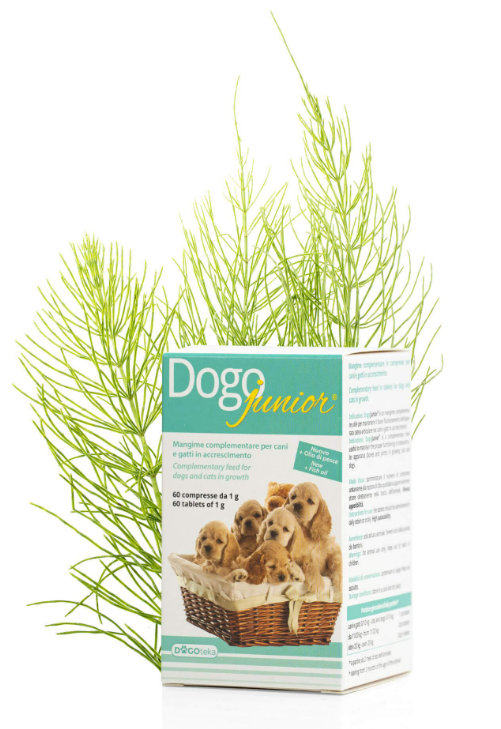
DOGOTEKA DOGOjunior 60 tablets.
DOGOTEKA DOGOjunior 60 tablets.
Couldn't load pickup availability
Description
Description
DOGOjunior®
Complementary food in tablets for growing dogs and cats. Improved formula with added FISH oil.
INDICATIONS
To promote the harmonious development of bones and joints in growing dogs and cats.
Active ingredients
GLUCOSAMINE SULFATE - from a chemical point of view, glucosamine is an aminomonosaccharide or monosaccharide, characterized by the fact that the hydroxy functional group is replaced by amino groups. Glucosamine is one of the main precursors of glycoproteins, in particular proteoglycans, macromolecules consisting of a central protein structure (core) to which are covalently attached disaccharide or glycosaminoglycan (GAG) structures, i.e. long, unbranched chains consisting of repeating disaccharide units alternating with aminosaccharides. All GAGs contain glucosamine derivatives.
Proteoglycans are the main components of the extracellular matrix of bone and cartilage connective tissue, non-covalently linked to long chains of hyaluronic acid, also chemically classified as glycosaminoglycans (GAGs). These large aggregates of proteoglycans and hyaluronic acid also contain proteins such as collagen, elastin and fibronectin, which makes the matrix itself more resistant. Therefore, glucosamine plays a very important role in the structure of these tissues, so its administration to growing dogs can be beneficial for the normal development of bones and joints.
CHONDROTINE SULFATE - chondroitin sulfate is a glycosaminoglycan (GAG), which in the form of proteoglycans is also a very important component of the extracellular matrix of bone and cartilage connective tissue.
Therefore, the use of glucosamine and chondroitin sulfate in puppies and kittens may be beneficial for strengthening bone and cartilage structures and for chondroprotection.
HORSE HORSE Equisetum Arvense - This plant is particularly rich in silica - both in the stem and in the leaves. Good amounts of silica are found in whole grains, seafood (shellfish), many vegetables (onions, sea buckthorn, strawberries, peas, drinking water and some mineral waters). In the last decade, some studies have recognized silica as a trace element that plays an important role in connective tissue, especially in bone and cartilage. Some abnormalities of bone and cartilage have been associated with a decrease in matrix components, highlighting the need for silica for the formation of collagen and GAG. The main effect of silica on bone and cartilage is on the organic matrix (consisting of collagen fibers) immersed in an amorphous substance of proteoglycans and GAG. It seems that the organic matrix of bone is more affected by silica deficiency than the mineralization process. Further supporting the metabolic role of silicon in connective tissue is the discovery that silicon is the major ion in osteogenic cells and is present in particularly high concentrations in the metabolically active state of the cell; moreover, the concentration of silicon in the mitochondria of these cells reaches relatively high levels. In animal models, deficiency of this element has been shown to result in defective joint formation, insufficient endochondral growth, and defects in articular cartilage. Therefore, horsetail may be beneficial for maintaining bone and cartilage function due to its silicon content.
Kelp (Laminaria digitata) is a source of various nutrients such as sodium, calcium, magnesium, iron, manganese, zinc, iodine, and provides all the benefits of these substances in a natural and non-synthetic form. The calcium in seaweed is an excellent food for babies.
SPIRULINA (Spirulina Maxima) is also an algae. Algae in general, especially their cell walls, are rich in polysaccharides, proteins and lipids. Spirulina has cleansing properties due to its polysaccharide component and antioxidant properties due to its phenolic acids, alpha-tocopherol and beta-carotene.
NEW ZEALAND GREEN-BLADE MUSSEL (Perna Canaliculus) - commonly known as green-lipped mussels. Some recent studies have shown that this food may be particularly beneficial for joint health. This property is attributed to many nutrients, but it seems to be particularly due to eicosatetraenoic acid (ETA), a polyunsaturated fatty acid belonging to the omega-3 group. Perna canaliculus has a mineral content similar to that of humans; it is rich in proteins, carbohydrates, glycosaminoglycans (glucosamine), lipids and, as already mentioned, minerals.
VITAMIN C is an antioxidant vitamin that helps form local collagen.
VITAMIN E - antioxidant effect.
SELENIUM - a mineral that supports the normal function of the immune system and is useful for protecting cells from oxidative stress.
FISH OIL - Contains fish oil, a well-known source of omega-3 polyunsaturated fatty acids. Omega-3 fatty acids, like omega-6, are considered essential fatty acids because the body cannot synthesize them, so these nutrients must be consumed through food. Polyunsaturated fatty acids, especially EPA and DHA, are recognized for their known health benefits, primarily their positive effects on heart function, blood pressure, and blood cholesterol levels.
ANIMAL FEEDING - food constantly produces acidic waste, and the body does everything it can to eliminate it. It is known that food rich in protein, especially of animal and to a lesser extent of plant origin, produces a lot of acidic waste, but the body is able to balance (neutralize) the excess of acidic substances by activating various mechanisms. However, if it does not have a sufficient amount of alkali (bicarbonates), it cannot neutralize these acids 100%. In such a situation, bones are the main mineral reserve from which the body draws them. This eventually leads to a loss of its mass, weakening it (weakening of the bones). The amount of calcium in a food product is not as important as the property of not removing calcium from the body. Therefore, it is important to always feed a balanced diet that contains nutrients such as proteins, carbohydrates and fats.
Composition
Products obtained from plant processing (horsetail (Equisetum arvense L.) powder 10%, kelp (Laminaria digitata) powder 5%, spirulina maxima powder 4%), glucosamine sulfate (from animal tissues) 10%, chondroitin sulfate (from pigs) 10%, maltodextrin, animal protein hydrolysate (from poultry liver), magnesium stearate, fish oil 1%, New Zealand green-lipped mussel (perna canaliculus) powder 1%.
1 tablet of 1 g contains:
Chondroitin sulfate (from porcine) 100 mg
Glucosamine sulfate (from marine crustaceans) 100 mg
Horsetail (Equisetum Arvense L.) 100 mg
Kelp (Laminaria Digitata) 50 mg
Spirulina Maxima 40 mg
New Zealand Green Mussel (Perna Canaliculus) 10 mg
L-glutamic acid 50 mg
Selenium 52.5 mcg
Vitamin C 60 mg
Dosage and method of administration
For cats and dogs up to 10 kg - 1 tablet
for dogs 11-20 kg - 2 tablets
for dogs over 20 kg - 3 tablets
Give the tablets with the daily feed portion or directly into the animal's mouth. Tasty tablets. From 2 months until full maturity.
Packaging: DOGOjunior® Supplementary food for cats and dogs, 60 tablets of 1 g each.
Share
 Reksas AI
Reksas AI
